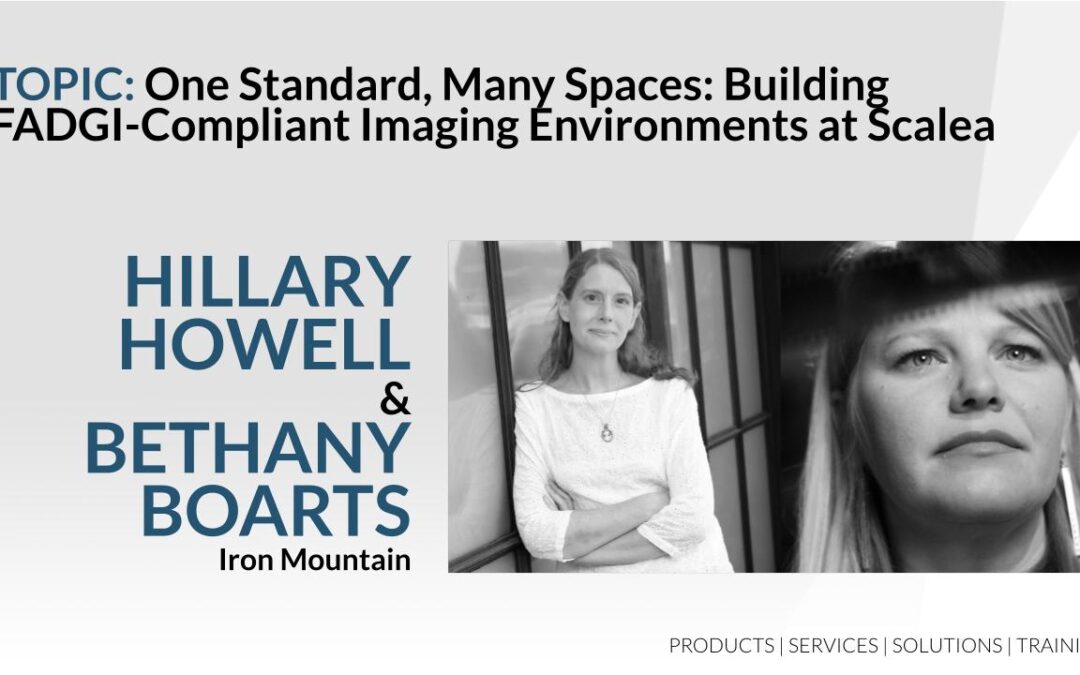
One Standard, Many Spaces: Scaling FADGI Compliance Globally
- Scaling high-end digitization requires rigorous environmental controls, transforming unconventional spaces like mines and vaults into FADGI-compliant studios.
- The “Studio in a Box” concept enables rapid, secure deployment of preservation-grade capabilities directly at the client’s location.
- Standardized equipment and a cross-trained “Imaging Task Force” ensure that quality remains consistent across global operations, regardless of the physical site.
For most digitization projects, the workflow is linear: assets are packed, shipped to a studio, imaged, and returned. But what happens when the assets, whether due to security, fragility, or insurance constraints, cannot leave their home?
For Hillary Howell and Bethany Boarts of Iron Mountain Media and Archive Services, the solution was to stop moving the assets and start moving the studio. In their presentation, they detail the logistical high-wire act of scaling from a single digitization center to a global network of over 20 specialized setups, all while maintaining strict FADGI 3-Star and 4-Star compliance.
The Challenge: Building Studios in Caves and Vaults
The mandate from Iron Mountain’s clients was clear: digitize the backlog, but do it on-premise. This requirement forced the team to become experts in retrofitting extreme environments. Boarts describes constructing imaging labs in a limestone mine in Boyers, Pennsylvania, and inside a literal bank vault in Hollywood.
These were not ready-made office spaces. Achieving FADGI compliance required rigorous site preparation. The team had to negotiate with contractors to paint the walls in specific shades of “5% Munsell Gray” to control color cast and to install vibration monitors to ensure that external factors (such as airplanes landing at a nearby airport) would not compromise the sensors’ sharpness. This “site prep” phase became as critical as the photography itself, ensuring that a studio built 200 feet underground could produce data quality comparable to that of a lab in a tech park.
Innovation in the Field: The “Studio in a Box”
To address the need for speed and flexibility, Iron Mountain developed the “Studio in a Box.” This modular solution packs six workstations, servers, and capture hardware into a transportable unit that can be deployed anywhere in the world. This innovation allows the team to set up a secure, self-contained digitization ecosystem at a client’s facility within days.
A key technical shift was the adoption of large-format scanning systems. By using hardware capable of capturing large engineering blueprints or fine art in a single shot, the team eliminated the time-consuming and error-prone process of image stitching. This efficiency is vital when working on-site, where time and footprint are often strictly limited.
Standardization as the Stabilizer
Howell and Boarts emphasize that while the locations change, the standard must not. To achieve this, they created an “Imaging Task Force,” a team of cross-trained specialists capable of working interchangeably across any site.
This human element is supported by rigid equipment standardization. By deploying the same DT Heritage hardware and Capture One workflows in London as they do in Pennsylvania, Iron Mountain ensures that the output is indistinguishable regardless of origin.
This consistency proves that scalability does not have to come at the cost of quality; with the right combination of robust hardware, standardized training, and environmental control, preservation-grade imaging can happen anywhere.
Standardize Your Digitization with DT Heritage Hardware
Iron Mountain relies on DT Heritage Hardware to maintain FADGI compliance across its global network of studios. From portable setups to permanent installations, DT provides the camera systems and stands that define the industry standard for consistency and quality.
Ready to build a scalable, compliant digitization workflow?