
Phase One Rainbow Multispectral Imaging Solution
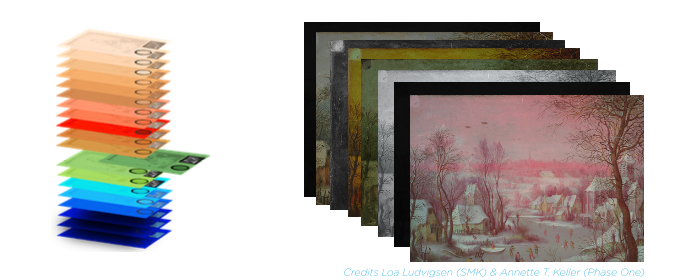
The Phase One Rainbow Multispectral Imaging Solution captures light across the electromagnetic spectrum, from visible to invisible wavelengths, using specialized camera technology, light sources, and filters. The resulting “stacks” of images are used to analyze substances and surfaces to determine readability, authenticity, age, material characterization, and distribution.
Multispectral imaging has traditionally been a technically complicated and cumbersome process. Based on Phase One Rainbow components, Digital Transitions’ Multispectral 150 megapixel Solution makes multispectral simple to use, accessible to a broad range of users, repeatable, and powerful. It’s used in a wide variety of disciplines to facilitate the capture and analysis of objects in the infrared, visible, and UV spectrums.

Applications of Multispectral Imaging (MSI)
- Document Analysis: Visual enhancement and readability optimization for damaged or deteriorated text on parchment, scrolls, and paper.
- Polychrome Surface Analysis: Non-invasive conservation work and authenticity verification for canvas, wood, stone, and multi-layered surfaces.
- Fabric Analysis: Historic research to determine age and material composition.
- Forensics and Crime Scene Investigation: Advanced detection of fluid residues, hidden fingerprints, weapon marks, and trace evidence on materials.
- Materials Characterization and Sorting: Quality assurance, material development R&D, and chemical composition differentiation for machine vision applications.
- Spectral Differentiated Response: Surface substance classification based on unique chemical reactions to specific light wavelengths.
Benefits of the Phase One Rainbow Solution
- Non-Invasive Contactless Analysis: Surface evaluation without physical degradation or handling risk.
- Rapid Preliminary Diagnostic: High-speed workflow verification under the “do it once, do it right” principle.
- Nondestructive Preservation Imaging: Low-energy LED illumination designed to protect highly sensitive original materials.
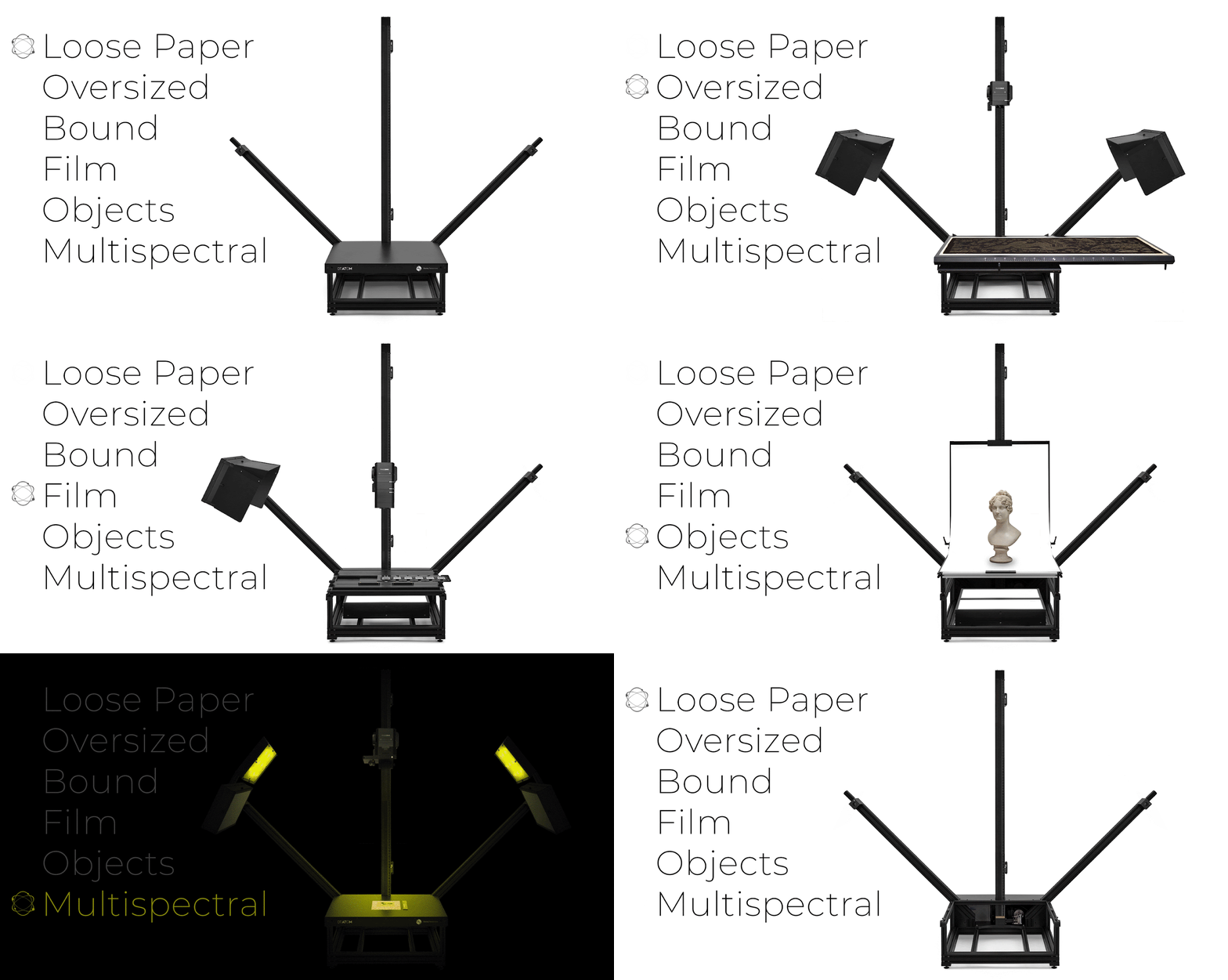
- Modular Deployment Architecture: Flexible capturing configurations engineered for both laboratory and mobile studio environments.
System Architecture and Integration
Accessible & Repeatable
- Turnkey Integration: Digital Transitions delivers a fully integrated, cohesive system combining the camera, lens, lighting, filter wheel, bench, software, training, and ongoing technical support.
- Automated MSI Workflow: The purpose-built Rainbow MSI Software executes complex recipes with a single click, automating focus, exposure normalization, flattening, and image alignment to output natively registered, distortion-corrected image stacks.
- Standards-Based Calibration: The automated calibration system ensures daily repeatability across multiple stations and directly complies with CHARISMA, FADGI, METAMORFOZE, ISO, and JHOVE preservation guidelines.
- Dual-Purpose Digitization: When multispectral analysis is not required, the system captures standard, guidelines-compliant color images in a single shot using an included IR/UV cut filter.
- Advanced Scientific Analysis: The software natively provides free access to advanced analytical toolsets, including Spectral Readouts, Principal Component Analysis (PCA), and Independent Component Analysis (ICA).
Powerful System Capabilities
- Unrivaled 150MP Resolution: Features a 150-megapixel BSI Sony CMOS Sensor capable of capturing full 48-inch (~A0) artwork at 300ppi in a single view, delivering industry-leading dynamic range, tone fidelity, and long-exposure quality.
- Comprehensive Material Filtration: Equipped with all necessary illumination and lens filtration to document both reflective and photo-induced luminescence content (such as reflected UV and UV fluorescence) across the spectrum.
- Flexible Band Illumination: Available with narrow-band illumination across 16 unique spectral bands for precise reflectivity analysis, wide-band illumination for rapid UV/VIS/IR capture, or a combination configuration for maximum flexibility.
- Transparent XML Metadata: The system preserves the entire raw image stack and embeds exact capture variables into standardized XML metadata, ensuring that files remain compatible with current and future analytical software.
- Industrial Build Quality: Every structural component is engineered for heavy institutional workloads and backed by a multi-year warranty.
The Science Behind Multispectral Imaging
- Market Transformation: Recent engineering breakthroughs in high-resolution, wide-spectrum digital camera sensors, custom LED illumination, and non-invasive conservation methodologies have advanced modern multispectral imaging applications.
- Spectral Customization: Programmable LED light sources target specific spectral bands, transitioning continuously from ultraviolet (UV) through the visible spectrum into infrared (IR) wavelengths.
- Reflected Wavelength Captures: Mid-range and deep light bands penetrate individual surface strata before reflecting back through customized camera filters. This process visualizes distinct subsurface layers, exposing underdrawings, hidden alterations, retouching, and obscured text on historical palimpsests.
- Photo-Induced Luminescence Recording: Target light energy excites surface compounds to induce longer-wavelength luminescence and fluorescence. The system records this behavior by deploying lens filters that mechanically isolate the luminescence while blocking out the primary shorter reflected wavelengths.
- Standardized Analytical Stacks: The resulting image stacks undergo automated scientific calibration against established baseline references, prepping the multi-layered spatial data for immediate empirical analysis.
- Statistical Processing Integration: The structured files integrate directly with advanced statistical computing tools—such as Principal Component Analysis (PCA) executed via specialized algorithmic libraries like MATLAB or Paleo Toolbox.
- Institutional Workflow Alignment: Integrated software applications include preconfigured workflows explicitly aligned with the British Museum’s CHARISMA project manual guidelines.

System Components
Rainbow MSI Software
Multispectral cameras have been available in the market for many years. Still, the calibration process, as well as the techniques for changing material sizes whilst maintaining consistent images that can be stacked and analyzed efficiently, have been challenging and have created significant overhead.
Phase One has worked with specialists on MSI projects for years. Based on this experience and learning, we have devised a flexible, easy-to-handle yet robust MSI solution with a workflow grounded in best practices.
The Rainbow capture process is fully automated: position the subject, then press ‘Capture’. The full stack of captures is then made with automated focus, automated “flattening”, automated exposure normalization, and automated alignment to deliver the perfect stack, again and again – with perfect repeatability and stability.
The Rainbow MSI software controls all the elements – focusing the camera, moving the filter carousel on the filter wheel, turning the lights on and off in the correct order and timing, aligning the images, and finally creating the perfect stack.
The Rainbow Filter Wheel
The filter wheel can hold up to five filters. It is configured to support the filtering needs of accurate visible imaging and luminescence imaging, which fits many applications, including the CHARISMA standard manual.
The carousel, which holds the filters, is removable and can be configured with any 2” filters for future scientific applications. The factory capture settings can be adjusted to suit different filter configurations. To support different MSI applications, you can work with two or more filter carousels.

The Rainbow Camera
The iXH 150MP and iXG 100MP cameras employ high-resolution, color-accurate CMOS sensors and advanced focusing to deliver sharp, reliable, and repeatable results across the entire range of wavelengths involved.
The Wide Spectrum RGB sensor, tailored for multispectral imaging, can also be used for normal digitization work. Just attach the included IR/UV cut filter to the lens using the provided stepping rings, and you are good to go, following Metamorfoze, FADGI, and ISO 19264 guidelines. “Do it once, do it right”.
The CMOS sensor provides a responsive live view for quick and safe positioning of the subject.
To keep out stray light, the camera comes with a custom lens shroud mounted on the filter reel.
Schneider Kreuznach 72mm and 120mm lenses are available for Phase One Wide Spectrum Cameras and are perfectly suited to a wide range of MSI imaging tasks, as well as standard flat copy digitization work.
The camera’s RS leaf shutter guarantees 1 million actuations. Working with the camera’s electronic shutter gives you infinite durability. The precise focusing mechanism measures distances accurately and enables Auto PPI functionality, making digitization at different resolutions quick and easy.
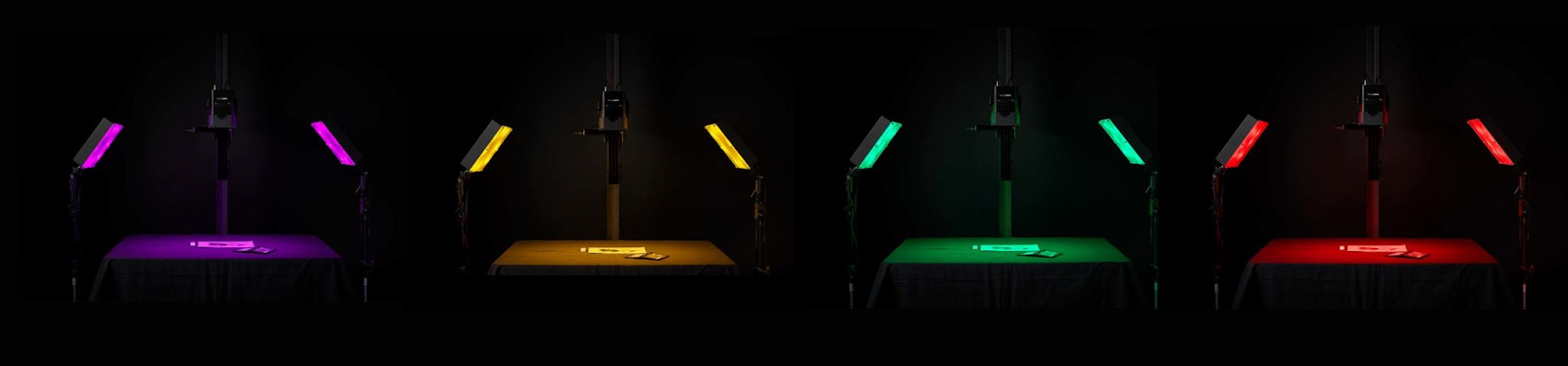
The Rainbow LED Lights
Rainbow supports two types of LED lights for a wide range of applications:
- Multiband DedoLight, delivering narrowband UV, broadband visible light, and broadband and narrowband IR. This light is often used for MSI applications related to Art Conservation and to Police Forensics. Recipes for capturing images in accordance with the CHARISMA standard manual are included.
- Narrowband EurekaLight delivers 16 narrowbands of light from UV through visible to IR. This light is often used for MSI applications related to Document Readability.
Revealing hidden text
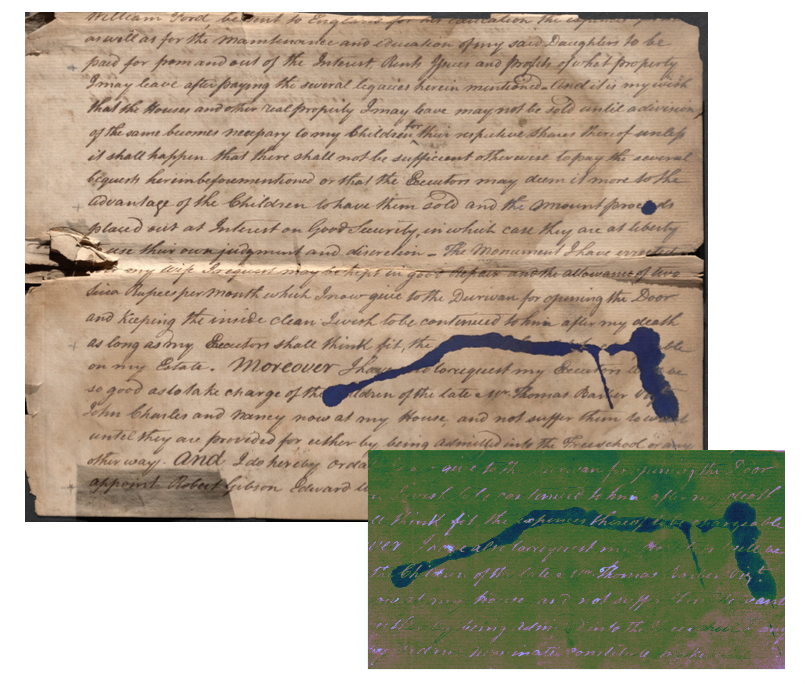
Some of the text in this old document has been obscured. With our narrowband MSI Solution, we can make all text visible and legible.
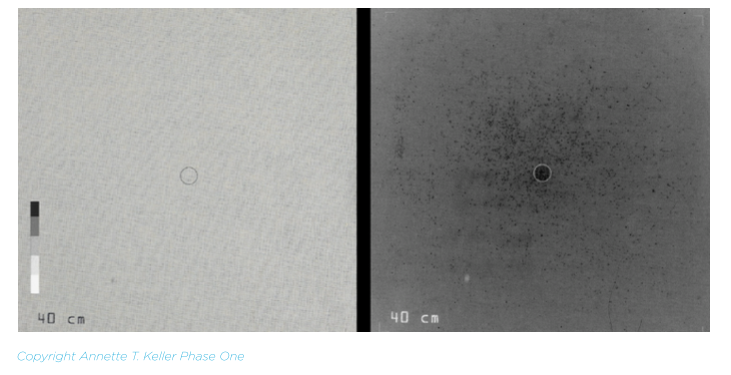
Police and Forensics
Many MSI analysis disciplines are applied in police work. Here is an example of gunshot residue – discovered by photo-induced IR Iuminescence.
Technical Specifications
| The Rainbow MSI Illumination Solution | ||
|---|---|---|
| Specification | Multiband Solution | Narrowband Solution |
| Included LED Lights | 2 x UV (365 nm w/ UG11 filters) 2 x VIS (w/ BG39 filters) 2 x IR (860nm & 960nm) |
16 Wavelengths (nm): 365, 385, 410, 420, 450, 480, 510, 530, 550, 600, 630, 640, 660, 740, 850, 940 |
| Configuration | 2 banks (UV, VIS, IR emission per bank) | 2 panels (16 LEDs per panel) |
| Filter Wheel | 5-position, automated USB control (Included) | |
| Connectivity | USB via 7-port powered hub | |
| Workflow Software | Phase One Rainbow MSI | |
| Standard Output | 8-image stack (Charisma Guidelines) | 16-image monochrome stack (Statistical Analysis) |
| Luminescence Output | 3 Channels | 15 Channels |
| Compatible Wide Spectrum Cameras | ||
|---|---|---|
| Specification | iXG 100MP WS | iXH 150MP WS |
| Sensor Size & Type | 53.4 x 40.0 mm CMOS Sensor | |
| Resolution | 100 Megapixels (11,608 x 8,708) |
150 Megapixels (14,204 x 10,652) |
| Pixel Size | 4.6 μm | 3.76 μm |
| ISO Range | 50 - 800 | |
| Data Interface | USB3 | USB-C / 10G Ethernet |
| File Formats | Raw 14-bit / Raw 16-bit | |
| Optics Compatibility | Schneider Kreuznach RS 72mm and/or 120mm | |
| Dimensions (w/ 72mm) | 174 x 130 x 130 mm (2.3 kg) | 177 x 130 x 130 mm (2.5 kg) |
| Environmental Limits | Operating Temp: 0º - 40º C | FCC Class A, CE, RoHS | |

Celebrating 20 Years of Digitization Excellence – 2003-2023
Subscribe to our Cultural Heritage Newsletter
