From Detail to Context: Digital Provenance as the New Standard in Digitization
- Technical perfection is not enough; a digital image must include its “digital provenance”—the context of its creation—to be truly valuable.
- Paradata, or the documentation of the digitization process itself, is essential for distinguishing between multiple valid representations of a single artwork.
- Integrating provenance data into Long-Term Preservation (LTP) systems ensures digital assets remain understandable and trustworthy for future generations.
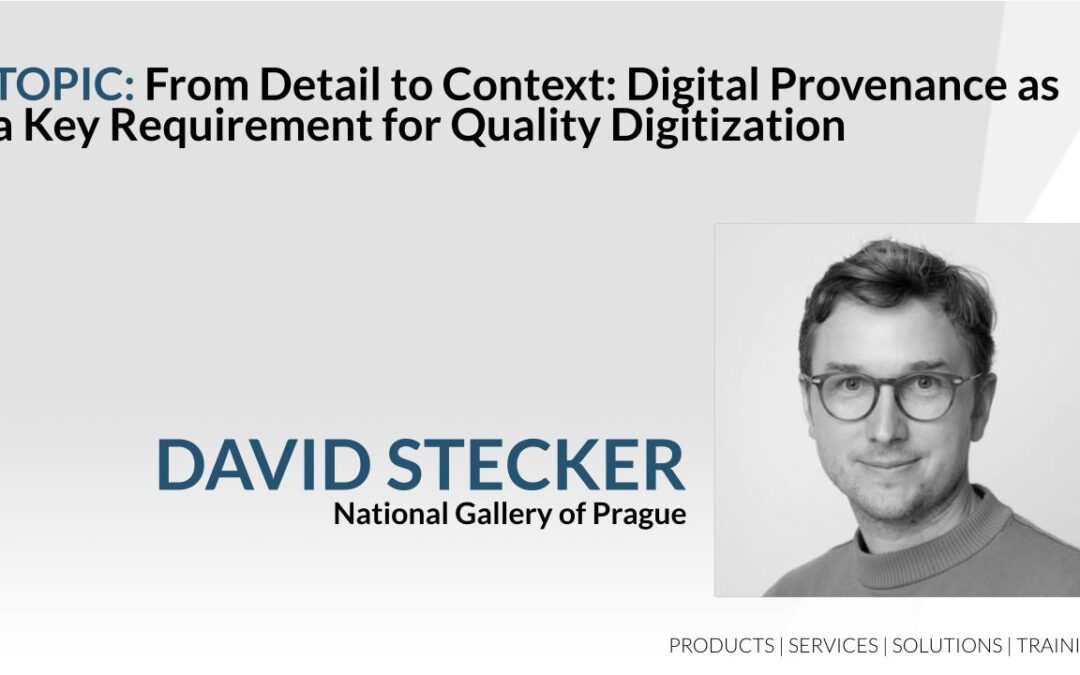
Cultural heritage digitization has long chased technical perfection: higher resolution, sharper focus, and more accurate color fidelity. However, David Stecker, Head of the Imaging Department at the National Gallery Prague (NGP), argues that we may be missing the forest for the trees.
In his presentation, Stecker posits that a technically perfect image is incomplete without its “digital provenance,” the critical context detailing how and why it was created. As NGP adopts advanced tools such as the DT Versa and large-format scanners, it is leading a shift from simply capturing pixels to preserving the entire narrative of the digitization process.
Beyond the “True” Image: The Role of Paradata
Stecker introduces the concept of paradata (metadata about the process) as a solution to the complex reality of art documentation. He challenges the notion of a single “true” image, demonstrating that an artwork can have multiple valid visual representations depending on the purpose. For example, a painting might need to be photographed under flat, even light for public presentation, but also under raking light for conservation analysis to reveal surface texture.
Without recording these conditions (the lighting angle, the equipment used, the object’s physical state), future users are left to guess. Stecker illustrates this with a compelling case study of a sculpture that, upon closer inspection of its metadata and history, turned out to be a photograph of a book plate rather than a direct capture of the object itself. By rigorously documenting paradata, institutions can distinguish between these versions, ensuring that a user knows exactly what they are looking at—whether it’s a “presentation version” for the web or a “documentation image” for researchers.
Capturing the Condition: Pre- and Post-Restoration
Digital provenance is also vital for tracking the physical history of the artwork. Stecker highlights the importance of documenting the object’s condition at the time of capture. He shares examples of artworks digitized before, during, and after restoration, noting that an “older” or “worse” image might actually preserve unique historical data, such as gems or details that were later removed or altered.
In this framework, no image is “obsolete” simply because a newer one exists. Instead, each image becomes a snapshot in time. By maintaining a clear record of when and why a photograph was taken (e.g., “before cleaning,” “during conservation”), the digital archive becomes a dynamic history of the object’s life, rather than just a static folder of files.
Building a Future-Proof Infrastructure
To manage this complexity, NGP is building a comprehensive IT infrastructure for Long-Term Preservation (LTP) that adheres to FAIR (Findable, Accessible, Interoperable, Reusable) and CARE principles. Stecker advocates a system in which technical provenance (bit-level security) and logical preservation (contextual meaning) go hand in hand.
This involves treating variables such as lighting setup, camera sensors, and capture software not as administrative trivia but as essential historical data. By integrating this data into their Digital Asset Management (DAM) system and using protocols like IIIF (International Image Interoperability Framework), NGP aims to create an interconnected web of knowledge. This ensures that a file opened twenty years from now retains not just its visual information, but its significance and trustworthiness as a historical record.
Capture Every Detail with the DT Versa
The National Gallery Prague utilizes the DT Versa to achieve the high-quality, versatile digitization required for their advanced provenance workflows. Capable of handling everything from bound books to flat art, the DT Versa provides the precision and adaptability needed for institutions committed to the highest standards of digital preservation.
Ready to elevate your institution’s digitization standards?