
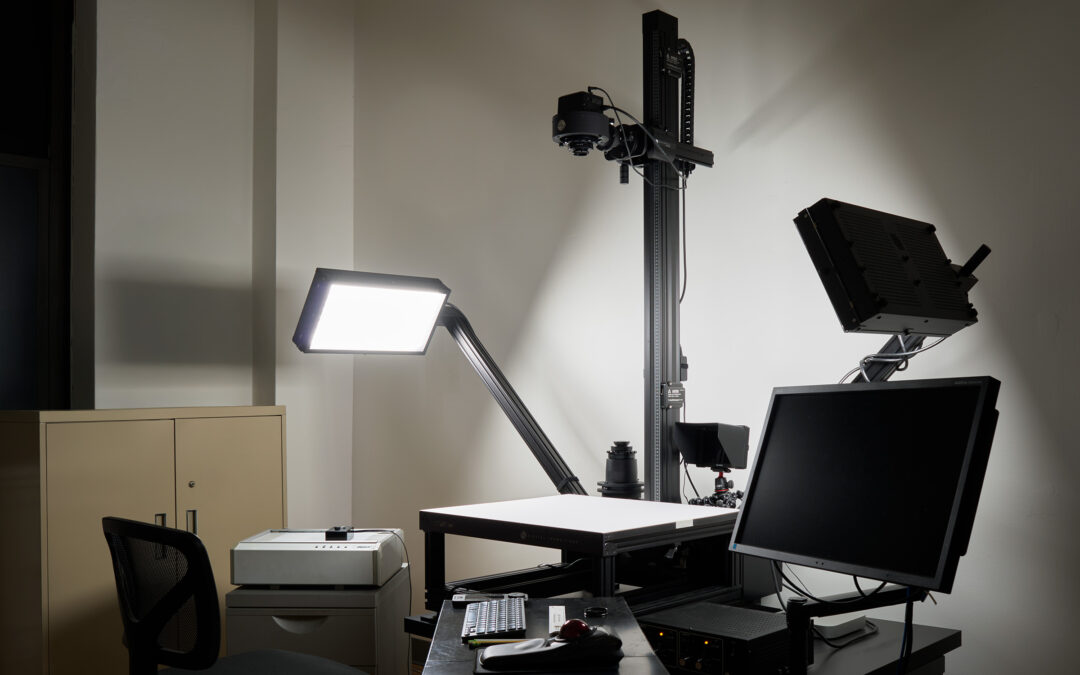
Digitization programs often focus on resolution, color accuracy, and standards compliance. However, operator ergonomics and workflow design have a direct impact on throughput, consistency, and material safety. In high-volume environments, small ergonomic inefficiencies compound into measurable productivity loss and increased handling risk.
This article outlines strategies for optimizing operator efficiency while protecting both staff and collections.
Adjustable Workstations
Digitization benches and copy stands should allow height adjustment for seated or standing workflows, easy camera column movement, clear sight lines to monitors, and stable, vibration-free platforms. Proper bench height reduces neck strain, shoulder fatigue, and repetitive stress injuries — all of which degrade throughput and accuracy over the course of a shift.
Reduce Repetitive Movement
Every unnecessary hand motion increases fatigue. Optimize for foot pedal or remote capture triggering, logical material staging with clearly separated incoming and outgoing trays, barcode integration for file naming, and automated cropping and deskewing tools. Efficient layout design can significantly reduce per-item handling time without sacrificing quality.
Lighting Position & Access
Lighting arms and fixtures should allow quick repositioning without tools, maintain consistent angles between sessions, avoid obstructing operator reach, and minimize glare on viewing monitors. Stable lighting placement reduces adjustment time and re-capture rates — two of the most common sources of throughput loss in high-volume labs.
Clear Visual Feedback
Operators benefit from large calibrated monitors, real-time focus magnification, immediate exposure warnings, and integrated QA alerts. Visual clarity improves first-pass accuracy and reduces downstream corrections — making investment in display quality a direct contributor to production efficiency.
Throughput Modeling
Measure production efficiency using items per hour per operator, setup time per batch, re-capture frequency, and post-processing time. Data-driven workflow adjustments allow continuous improvement over time and make it easier to identify where ergonomic friction is degrading performance.
Fatigue Mitigation
High-volume digitization is inherently repetitive. Institutions should implement scheduled micro-breaks, rotational task assignment, anti-fatigue floor mats, and adjustable seating with lumbar support. Reducing fatigue lowers error rates and improves long-term staff retention — both of which have measurable financial impact on program costs.
Design for Scalability
An ergonomic lab should be modular. Plan for additional stations, shared lighting systems, expandable storage staging, and networked capture environments. Scalable layouts prevent costly reconfiguration as programs grow and allow institutions to add capacity without disrupting existing workflows.
Conclusion
Operator ergonomics is not a secondary consideration — it directly affects quality, safety, and productivity. Institutions that intentionally design efficient, comfortable workflows achieve higher throughput, lower rework rates, and more sustainable digitization programs over the long term.
More Information
For more information on digitization lab design or workflow optimization, contact us.
Related resources