

Every unnamed face in your archive is a mystery. DT Identify makes it faster and easier to investigate them.

A finished capture is a starting point, not an end point. A folder of digitized photographs tells you almost nothing about who’s actually in them, and manually identifying people across a large photo or film collection — decade by decade, box by box — is one of the most time-consuming jobs in any archive. DT Identify is DT DigiLabs’ facial recognition and identity search product, built to do that work at a scale no cataloging team can match by hand, whether the images are ones DT DigiLabs captured or a collection you already have.
What Makes It Different
Off-the-shelf facial recognition tools are built for security and social media, not archives. They expect born digital images from iPhones and security cameras, not images of archival photographic originals and photographic prints. DT Identify is tuned for the material cultural heritage institutions actually have.
Two things set it apart from a generic recognition tool:
- Clustering before naming. DT Identify doesn’t wait for a name to start being useful. It groups all the unidentified appearances of the same person together first, so your team identifies a face once — not image by image. That turns a task that scales with your collection size (name every photo) into one that scales with the number of unique people in it, which is almost always dramatically smaller.
- Known-person matching plus institutional knowledge. Public figures are matched automatically against standard reference databases. Everyone else — staff, donors, local officials, the people only your institution’s own experts would recognize — gets identified by the people who actually know them, working from pre-grouped clusters instead of a raw image pile.
What It Does
- Identifies notable individuals across large photo and film collections
- People search — finds every photo of a specific person across decades of material in seconds
- Clusters unidentified faces so your team names a person once, not image by image
- Generates face-based metadata automatically, attached to each asset for future search
Who It’s For
- Sports archives — identifying athletes, coaches, and staff across decades of team photography
- Media & entertainment — identifying cast, crew, and public figures across production stills and press photography
- Museums & archives — identifying previously unnamed subjects in historic photography
- Government & institutional archives — identifying officials, ceremony attendees, and event participants
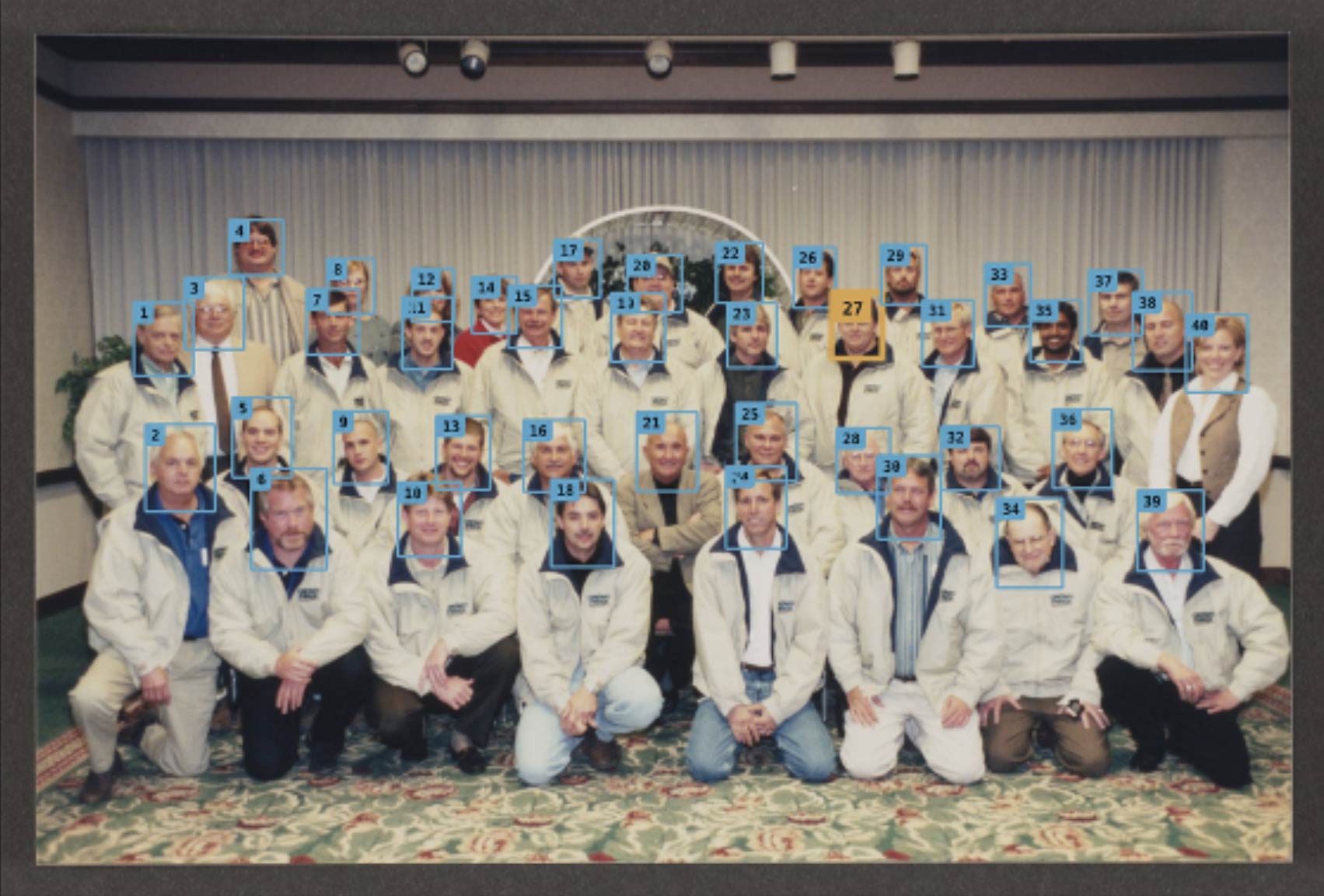
Typical Use Case: An Institutional Photo Archive with More Faces Than Staff Hours
The clearest example of DT Identify in practice is currently underway at the NASCAR Hall of Fame, working with Curator of Collections Siera Erazo on a photography archive estimated at 300,000 to 500,000 images spanning more than half a century of motorsports. Facial recognition finds and clusters faces across the collection; well-known drivers are matched automatically against standard reference databases, and Hall staff — some of whom worked in NASCAR themselves — review the remaining clusters and name the crew members, executives, and others no public database would recognize.
That review step matters as much as the automation. Early in the project, the system confidently matched a face to driver Richard Petty in one frame. Two curators flagged it, and the Hall’s executive director recognized the actual subject immediately: Eric Horn, a Petty Enterprises crew member with a surprisingly similar face, photographed changing a rear tire — a job Richard Petty, mid-race, was never doing. The error was caught before it ever reached the collection database. It’s a small story, but it’s the whole design philosophy of DT Identify in miniature: AI handles the volume, and the people who actually know the collection have the final say.
RESPONSIBLE AI: DT Identify’s matches are AI-assisted candidates, not final answers. Every result is designed to be reviewed and confirmed by a person on your team before it’s published or relied on — DT Identify accelerates identification, it doesn’t replace institutional judgment.
Works on What You Already Have
DT Identify runs on the same high-fidelity raw captures produced during a DT DigiLabs digitization project — but it doesn’t require one. It works just as well on a collection you already digitized somewhere else. If your institution is sitting on a “dark” photo archive nobody has had time to identify, DT Identify can be the first step toward making it searchable, with or without a new capture project attached.
Pairs Well With
- Digitization & Capture — start with a fresh capture, then identify
- DT Registrar — combine identity search with object and content metadata for full collection search
If your institution has more faces than hours to name them, DT Identify can help. Talk to our team about your collection.